Pre-Production for Final Project
The aim of this pre-production phase is to systematically plan, research, and define the creative direction of the Final Project before execution. Students are required to develop conceptually strong and visually coherent ideas that translate abstract emotions, narratives, or themes into intentional photographic series.
Blueprints of Vision: Research & Creative Direction


Straight Outta the 90s
Fashion in the 1990s
The world moved on from the excesses of the 1980s in the 1990s towards a more relaxed, fragmented, and connected world. Across the world, the look of the period was divided essentially between Minimalism, and Anti-Fashion/Grunge. Economies of different regions determined which look was adopted. Fashion in the 1990s was largely a and was a reaction to the elaborate fashions of the 1980s that preceded it. The decade’s influence was streetwear, glam and grunge – all three of them. Two key styles included the worn-out grunge look with flannel shirts worn with ripped jeans, and a mainstream popularization of casual chic, which included T-shirts, hoodies and sneakers. Rapper trousers, widely adopted in hip hop, gave rise to baggy pants. The period borrowed from styles of previous decades, supermodels like Kate Moss defined this era
Fashion of 1990s A Global and Indian Perspective
The 1990s saw a subdued move away from the high-volume excesses of the 1980s towards a more minimalist approach with low-maintenance designs and an emphasis on individualism. A mixture of many things like streetwear, glam, minimalism, and grunge defined the era. From supermodels to the beginning of subcultural styles in fashion to globalization of fashion thanks to the introduction of the internet and satellite television, Fashion in the 1990s was noteworthy
Global Fashion Trends of the 1990s
The ten years are split into key parts each having its own styles for men and women.
Early 1990s (1990–1992)
-
Layover of the 80s : the styles of the late 1980s went on, with a lot of neon and fitness gear. Many of the items women choose were loud geometric prints, shiny spandex leggings, bike shorts, and black leather jackets with shoulder pads. The women used to wear big T-shirts or sweatshirts and wore those over turtlenecks with leggings and slouch socks. For guys, sportswear like yellows, pinks, or greens wind-breakers, polo shirts, and chinos tucking into the ankles, remained popular.
-
Beginnings of supermodels: the fashion trade was run by supermodels. They called the ’Big Five’ them. Bark them big name were Naomi Campbell, Cindy Crawford, Christy Turlington, Linda Evangelista and Tatjana Patitz. Later, two more women were swerve to the same elite club. They were Claudia Schiffer and Kate Moss. Moss, then, put on the trendiest, but bad, look which was called her not-so-cute heroin chic.
-
Grunge Turns Main: The biggest new thing was grunge, which came from the alternative rock world in the Pacific Northwest. It was a rough, layered style with flannel shirts, baggy jeans, Doc Martens, combat boots, and band T shirts for boys and girls. This anti style of style was a big part of the decade.
Mid-1990s (1993–1996)
-
Fem and glam wear: Grunge was hot till around 1994, when softer, sexier, more fitting stuff took over. Slip dresses over a tiny white t shirt were the thing. The sexy school girl look, seen in films like Clueless, had tartan blis miniskirts, knee high socks, and chunky shoes. High gloss stuffs like satins, shiny metals, and vinyls took over night and work wear
-
Denim and casual clothes: Denim was everywhere. High-waisted, ankle length mom jeans was a must wear. For men, hip hop style went big, with what seemed like giant T shirts, baggy jean pants, sports coats, and athletic wear from FUBU, Tommy Hilfiger, and other brands. The new preppy style was a hit in the US, with a relaxed preppy look using khakis, boat shoes, and striped boat shirt.
-
Britpop and Revivals : In the UK, the Britpop bands Oasis, Blur did well, so the 1960s Mod look and 1970s styles came back. They wore denim jackets, parkas, paisley shirts, and velvet blazers
Late 1990s (1997–1999)
-
Casual Chic and Streetwear: The end of the decade saw a unisex casual chic style, with designer denim, tracksuits, sweatpants, and spaghetti strap crop tops enjoying popularity. Major labels like Calvin Klein and Ralph Lauren became popular again
-
70s Disco comeback : A lot of clothiers looked to the disco era of the 1970s, and brought back pleather trousers, animal print, halter necks, metallic fabrics, and boot cut trousers. Platform shoes became big too
-
Y2K Style: In the lead up to the new 2000s, makeup and style went ahead as if from the future and shined like stars. This Y2K makeup was face glitter, shiny lips, and blue icy or silver eyeshadow
-
Worldwide Impact: Style went global. Big pressure form Africa and Asia on US catwalks.
Indian Fashion 1990s The Bollywood Effect
Key Trends and Icons: Bollywood style had shiny sequins, high-waisted denims, chiffons, denim shirts, and crop tops. Actress Karisma Kapoor and Raveena Tandon wore the combo cool with color co-ord set and power suits. Madhuri Dixit made sarees in movies like Hum Aapke Hain Koun to make a new trend for a new generation. Stars like Salman Khan and Aamir Khan also made the streetwear look simple with a pair of jeans, sneakers, and a tank top.
Global Recognition and Fusion:
Since 1997, Indian style has been more known to the world press in part because of the creation of the Fashion Design Council of India, and for hosting India Fashion Week.
Taking from Bollywood, and a 1970s comeback, Indian designers gave the traditional garb a fresh look as a saree, churidar and kurta. The kurta tunic was shorn into sexy dresses and Manish Arora made those big Hindu, God printed T-shirts.
Western makers also used traditional cloths such as khadi, paisley, silk, and Batik from Indonesia in Western dress, a style that South Asian and non-Indian women wore.
🎯 AIM OF THE PROJECT
My goal for this photoshoot was to create a visual take on 90s street fashion that combined its gritty, loud personality with new styling and trends. I wanted to show how 90s styles, mainly streetwear fueled by hip-hop and urban culture, still influence how young people dress today with shapes, add ons, and mood. Instead of copying the 90s directly, I set out to update it for a modern view while keeping the heart and soul of those styles.. I wanted to make that style feel like it belongs to today without losing its sense of freedom, individuality, and the celebration of speaking your mind and dressing how you want. In this work, I also want to show how fashion keeps coming back in new forms over time and how old trends can mean new things now. With a city background, vintage objects, and modern outfits, I seek to form a powerful image that links the old with the new street style. I hope to send a message that fashion never truly dies, changes, or leaves us; it is an important part of each person's self.
Concept Note
In this photo shoot, I made the choice on purpose to wear this all meant to show the raw black skated out, ground street wear style of the 90s and now. I wear the big black grafix tee is the base of the fit because black is the color of control, fighting back, and not caring its the color that says you got everything going for you speak louder without your words or body language. I go with the off white cargo jogg rs to bring down the dark and heavy feel that the tee has but also brings an over utility vibe that just looks like street stuff and the freedom to move. I wore it baggy on the top on purpose because the point was to show that you dont have to play by rules that heavy fashion plays with instead, be yourself and stand on it and fight. The red and black bandana is a strong style choice. Red gives energy and strength, and the bandana is a style icon for the streets, for rap, and for self style. Sitting round metal glasses over her bandana is not just a style choice, its a sign too giving the wearer personality and a rebellious attitude It looks like someone who watches the world on her own terms. The layered metal jewelry including the choker chain necklace and metal cuff all give the whole thing an icy, factory feel that makes the whole thing look even tougher without taking away from the power of the look. I used sneakers and seen socks so the style felt like a real life than a high fashion look. This choice goes with the way things are for real, and shows the character in the streets not in a fine arts space. The retro radio on the floor is a visual metaphor. It shows you a voice from the past, a thought from an older time. It connects old culture with new street style, and it feels like the rhythm of the music and the mood of the shooting space is all in the mind. The mood of this shoot is cool but strong. The body positions are chill but not weak, they show power but not rage. I wanted the girl to feel like she had her feet on the ground, like she knows who she is and she owns that space. By shooting with rough city backgrounds like shutter doors and street art walls, I wanted to make a conversation between the girl and the city where fashion, life, and who you are mix together. This shoot is not about following the crowd, it is about attitude, finding your place and walking it in a city that never stops.
Styling Breakdown
In this photo shoot, I made the choice on purpose to wear this all meant to show the raw black skated out, ground street wear style of the 90s and now. I wear the big black grafix tee is the base of the fit because black is the color of control, fighting back, and not caring its the color that says you got everything going for you speak louder without your words or body language. I go with the off white cargo jogg rs to bring down the dark and heavy feel that the tee has but also brings an over utility vibe that just looks like street stuff and the freedom to move. I wore it baggy on the top on purpose because the point was to show that you dont have to play by rules that heavy fashion plays with instead, be yourself and stand on it and fight. The red and black bandana is a strong style choice. Red gives energy and strength, and the bandana is a style icon for the streets, for rap, and for self style. Sitting round metal glasses over her bandana is not just a style choice, its a sign too giving the wearer personality and a rebellious attitude It looks like someone who watches the world on her own terms. The layered metal jewelry including the choker chain necklace and metal cuff all give the whole thing an icy, factory feel that makes the whole thing look even tougher without taking away from the power of the look. I used sneakers and seen socks so the style felt like a real life than a high fashion look. This choice goes with the way things are for real, and shows the character in the streets not in a fine arts space. The retro radio on the floor is a visual metaphor. It shows you a voice from the past, a thought from an older time. It connects old culture with new street style, and it feels like the rhythm of the music and the mood of the shooting space is all in the mind. The mood of this shoot is cool but strong. The body positions are chill but not weak, they show power but not rage. I wanted the girl to feel like she had her feet on the ground, like she knows who she is and she owns that space. By shooting with rough city backgrounds like shutter doors and street art walls, I wanted to make a conversation between the girl and the city where fashion, life, and who you are mix together. This shoot is not about following the crowd, it is about attitude, finding your place and walking it in a city that never stops.


When Anime Becomes Real
History of Anime
The story of Japanese animation, or anime, is a complex tale of creative originality, cultural change, and world expansion that dates back to the beginning of the 20th century. Its origins can be linked to traditional entertainment like emakimono (narrative scrolls) and kagee (shadow play) that were the precursors of contemporary animation.
Early Origins
(1900s–1940s)
The earliest Japanese animated films were created in the 1910s and were influenced by Western animation techniques. While a filmstrip called Katsudō Shashin may have been created as early as 1907, whether this is actually the case is still uncertain. The first verifiable animated film in Japan came in 1917. Ōten Shimokawa, Jun'ichi Kōuchi, and Seitarō Kitayama are sometimes referred to as the "fathers of anime". Many of the early films have been lost, particularly after the Great Kantō Earthquake of 1923 which devastated Kitayama's studio and his entire collection
During the prewar years, animators had competition from foreign producers, particularly Disney, and their limited budgets (often using inferior cutout animation instead of more expensive celluloid) made it difficult to compete. Beginning in the 1930s, the Japanese government imposed cultural nationalism that restricted animators to producing propaganda and educational films. Advance of cine-taped animation, like the first talkie anime, Chikara to Onna no Yo no Naka (1933), and then in 1945, the first feature-length anime film, Momotarō: Umi no shinpei, produced for the navy during WWII, with advancements made throughout the pre-war years.
Post-War Growth and the Rise of Television (1950s–1970s)
Following the end of World War II, the anime industry began to reorganize. In 1956, Tōei Animation was started with the intention of becoming the "Disney of the East." Three years later, they premiered Japan's first color anime feature film, Hakujaden (The Tale of the White Serpent). The era also hosted several significant animators to the industry, such as Hayao Miyazaki and Isao Takahata, who started out at Tōei. The creation of television-based anime was a major change for anime in the 1960s. In 1963, Osamu Tezuka, sometimes known as the "God of Manga", developed, and launched the overwhelming success of Astro Boy (Tetsuwan Atomu) which was the first widely produced anime series made for television. television in the United States and introduced the building blocks of what we would call the modern anime industry today. In order to control their production budgets, Mushi Production developed the traits that define limited animation, which established a style. The first magical girl anime, Sally the Witch (1966), premiered during the 1960s, along with what would become the longest-running anime program, Sazae-san (1969), which continues to be aired. The 1970s was an era of divergence in genres, including mecha (giant robots) and space opera, emerging with series such as Mazinger Z (1972), Space Battleship Yamato (1974), and Mobile Suit Gundam (1979). Some anime began reaching European audiences with animated shows such as Heidi, Girl of the Alps (1974).
The Golden Age and Global Expansion (1980s–2000s)
The 1980s is seen as a golden age for anime. One of the main events that happened in the decade was the increase in anime production and the rise of the subculture dubbed "otaku". After the global success of films such as Nausicaä of the Valley of the Wind (1984), Hayao Miyazaki and Isao Takahata established Studio Ghibli in 1985. The home video market grew rapidly with the introduction of the Original Video Animation (OVA) format of anime that permitted more experimentation into animation and more mature content. Iconic series Dragon Ball (1986), and the film Akira (1988) were two of the many notable productions of this time, they were a notable anime phenomenon that contributed to the global audience of animation productionsThe 1990s saw anime develop into an international global pop culture phenomenon with series such as Dragon Ball Z, Sailor Moon, and Pokémon achieving worldwide popularity and recognition. This decade also began to see the growth of influential cultural works such as Neon Genesis Evangelion (1995) and the cyberpunk film Ghost in the Shell (1995), the latter having wide-ranging influences on later Western media, most notably the movie The Matrix. The Studio Ghibli film Princess Mononoke (1997) became the most expensive anime film produced at the time.The 2000s were a pivotal time for anime to really grab a foothold in U.S. and international markets, thanks in large part to the internet and programming blocks like Adult Swim's Toonami. Hayao Miyazaki’s Spirited Away (2001) won the Academy Award for Best Animated Feature in 2003, which was a major moment for the industry. There were also many different genres during the decade, such as adaptations of visual novels and late-night series that were purely experimental.
The Modern Era (2010s–Present)
Streaming services like Crunchyroll, Netflix, and Amazon Prime Video emerged in the 2010s and 2020s, making anime more accessible than ever and continuing to drive immense global popularity. World-wide smash hit shows like Attack on Titan (2013) and Demon Slayer: Kimetsu no Yaiba have become incredibly popular worldwide, with Demon Slayer: Kimetsu no Yaiba – The Movie: Mugen Train (2020) breaking records to become the highest-grossing film of 2020, and the highest-grossing Japanese film ever. Most recently, Hayao Miyazaki's The Boy and the Heron (2023) won the Academy Award for Best Animated Feature, again representing another significant international achievement for the industry
Demon Slayer: Kimetsu no Yaiba
Demon Slayer: Kimetsu no Yaiba is a highly successful Japanese manga series written and illustrated by Koyoharu Gotouge. Serialized in Weekly Shōnen Jump from February 2016 to May 2020, the story follows a kind-hearted teenager named Tanjiro Kamado, who becomes a demon slayer after his family is murdered and his younger sister, Nezuko, is turned into a demon. The series is set in Taishō-era Japan, where a secret organization called the Demon Slayer Corps has been fighting demons for centuries. The franchise has become one of the highest-grossing of all time, generating an estimated annual sales revenue of ¥1 trillion ($8.75 billion) in 2020 and significantly impacting Japanese pop culture and even the publishing industry.
Story and Setting
The plot centers on Tanjiro's quest to find a cure for his sister Nezuko and avenge his family. He joins the Demon Slayer Corps, an organization of humans who use special elemental breathing techniques to fight demons. Demons possess supernatural abilities and can only be killed by sunlight, decapitation with a special Nichirin blade, or wisteria poison. The most powerful slayers in the Corps are known as the Hashira, or Pillars. Along his journey, Tanjiro is joined by fellow slayers Zenitsu Agatsuma and Inosuke Hashibira. Their battles against the Twelve Kizuki, the most elite demons under the command of the demon king Muzan Kibutsuji, form the core of the narrative.
Key Character: Shinobu Kocho, the Insect Hashira
One of the most distinct characters in the series is Shinobu Kocho, the Insect Hashira. Unlike her fellow Hashira, Shinobu lacks the physical strength to decapitate a demon. To compensate, she developed the unique Insect Breathing style, a fighting technique focused on stabbing and injecting demons with a lethal, wisteria-based poison. Her sword is a modified katana with a thin, needle-like tip designed for this purpose. Shinobu's character is defined by contradictions. She presents a calm, polite, and gentle exterior, which masks a deep-seated rage stemming from the death of her older sister, Kanae, at the hands of the Upper Moon demon, Doma. Her constant smile is a facade to hide her true emotions. This duality is also reflected in her visual design, which is heavily inspired by butterflies—symbols of the soul, transformation, and fragility in Japanese culture. Her haori (kimono jacket) features a butterfly wing pattern, and her hair is styled with a butterfly ornament. Shinobu also serves as the head healer of the Demon Slayer Corps at the Butterfly Mansion, where she and her adoptive sister, Kanao Tsuyuri, care for injured slayers. Her medical expertise is extensive, and she plays a crucial role in developing potent poisons to fight powerful demons. To defeat Doma, she ultimately transforms her own body into a vessel of poison, saturating it with 37 kilograms worth of a highly concentrated wisteria-based toxin in a final act of vengeance.
Media and Adaptations
The Demon Slayer franchise extends far beyond its original manga, which consists of 23 volumes. The success of the series was massively amplified by its anime adaptation produced by the studio Ufotable.
Anime Television Series: The anime has aired multiple seasons, including the "Tanjiro Kamado, Unwavering Resolve Arc" (2019), "Mugen Train Arc" and "Entertainment District Arc" (2021), "Swordsmith Village Arc" (2023), and "Hashira Training Arc" (2024)
Films: The sequel film, Demon Slayer: Kimetsu no Yaiba – The Movie: Mugen Train (2020), became the highest-grossing Japanese film and the highest-grossing film of 2020 worldwide. A film trilogy adapting the "Infinity Castle" arc is also in production.
Other Media: The franchise includes light novels, spin-off manga, video games like The Hinokami Chronicles, stage plays, and extensive merchandise.
Cultural Impact and Reception
Demon Slayer has achieved monumental success, becoming one of the best-selling manga series of all time with over 220 million copies in circulation as of July 2025. It was the best-selling manga in Japan in both 2019 and 2020. The series has received critical acclaim for its storyline, characters, and high-quality animation. Its popularity is so widespread in Japan that a 2020 poll found over 90% of the public was familiar with it. The series has also won numerous awards, including a Special Prize at the 25th Tezuka Osamu Cultural Prize ceremony.
Shinobu Kocho is a pivotal character in the manga and anime series Demon Slayer: Kimetsu no Yaiba. As one of the Hashira, the highest-ranking combatants in the Demon Slayer Corps, she holds the title of the Insect Hashira. She is a complex and contradictory figure, known for her gentle appearance that conceals a deadly strength and a deep-seated rage.
Shinobu Kocho
Appearance and Symbolism
Shinobu is a petite young woman, standing at 151cm tall and weighing 37kg. Her design is heavily influenced by butterflies, which in Japanese culture can represent the soul, fragility, transformation, and a short life. This symbolism reflects her character's duality: she appears delicate but is powerfully lethal.
Physical Features: She has shoulder-length hair that fades from black to dark purple, styled in a bun with a butterfly ornament. Her large, violet eyes lack distinct pupils, giving them an insect-like, mysterious appearance.
Attire: She wears a standard Demon Slayer uniform with a distinctive white haori (kimono jacket) featuring a butterfly wing pattern that fades into shades of green, turquoise, purple, and pink. This haori was inherited from her late sister, Kanae.
Backstory and Personality
Shinobu's personality is a carefully constructed mask. She typically presents a calm, polite, and cheerful demeanor, even when in tense situations. However, this facade hides a white-hot, palpable anger and an intense hatred for demons, which stems from a tragic past. Years before the main story, Shinobu and her older sister, Kanae, were the sole survivors of a demon attack that killed their parents. They were rescued by the Stone Hashira, Gyomei Himejima, and subsequently joined the Demon Slayer Corps to prevent others from suffering a similar fate. In her youth, Shinobu was brash, quick to anger, and short-tempered. Her personality drastically changed after Kanae, then the Flower Hashira, was killed by the Upper Moon demon, Doma. To honor her sister's dying wish to find harmony between humans and demons, Shinobu adopted Kanae's gentle personality, all while nursing a relentless desire for vengeance. This internal conflict makes her character deeply layered and complex.
Role and
Final Fate
In the narrative, Shinobu acts as a mentor, primarily to her adoptive younger sister, Kanao Tsuyuri. While she helps train the series' protagonists at the Butterfly Mansion, her focus remains almost exclusively on Kanao, subverting the typical shonen mentor archetype. Her ultimate goal is to avenge her sister by killing Doma. To achieve this, she undertakes a drastic final measure. With the help of the demon doctor Tamayo, she transforms her own body into a poison bomb, saturating it with 37 kilograms of highly concentrated, undetectable wisteria poison that merges with her very cells. During the final battle, she allows Doma to absorb her, poisoning him from the inside. This act of self-sacrifice severely weakens the Upper Moon, ultimately leading to his defeat and fulfilling her lifelong quest for vengeance.
My Contribution and Aim
For this creative photography project, my contribution and goal is to represent the fictional character Shinobu Kocho from the Japanese manga and anime Demon Slayer: Kimetsu no Yaiba into a real visual representation through the application of cosplay photography. Shinobu is appreciated for her personality being laid back and her soft spoken voice and the true strength that lies behind her gentle smile, but also for her beauty, discipline, and kind heart. These elements are what I hope to embody visually in my imagery. This project will attempt to combine fantasy story telling with cinematic visuals, encapsulating an image or a photograph in which the depiction feels both true to the character and creatively represented in photography.
The idea of this project aims to represent Shinobu’s tranquil and composed energy with a singular image that speaks self-sufficiently. She is typically portrayed in a still frame of nearly her iconic pose, without hesitation and with an amicable look on her face, alluding to her butterfly points. This bare foundation of a photo shoot outlines my goal of capturing that inspiration; to immerse and recreate that with every minor detail of intention, including the angle of her head, positioning of sword and drape of her haori.
Concept and
Visual Direction
The cinematic aspect will focus on framing, color balance, and depth, using lens perspective and composition techniques to make the character appear larger than life while maintaining realism.
The fantasy element will come through the lighting, props, and background atmosphere — such as soft mist, floating petals, or glowing particles that hint at a magical world.
The overall mood and pose will be calm and peaceful, reflecting Shinobu’s inner serenity and strength. The visual tone will lean toward subtle emotion rather than intensity — something that invites viewers to pause and feel rather than just look.
Styling and Costume Design
Styling will play a major role in achieving authenticity. The costume will closely resemble Shinobu’s original outfit, featuring:
A butterfly-themed haori in shades of white, purple, and mint green
A katana (sword) designed to match her distinctive insect-like blade.
A katana (sword) designed to match her distinctive insect-like blade.
Makeup will be kept soft and natural, with attention to her gentle eyes and light lip tone. The goal is to maintain a balance between realistic cosplay accuracy and photographic elegance, ensuring that the final look complements the lighting and color palette.
Lighting and Technical Approach
Lighting will be one of the most expressive tools in this shoot. I plan to use neon and dramatic lighting techniques to create a fantasy-inspired yet cinematic feel.
Key Light: A soft directional light to highlight facial features gently
Backlight or Rim Light: To create a subtle glowing outline, adding depth and separation from the background
Colored Lighting (Purple Tones):
To enhance the fantasy mood and connect with Shinobu’s theme colors.
The environment will be minimalistic, focusing on mood rather than heavy set design. I will also use reflectors and diffusion sheets to soften harsh shadows and maintain a calm, ethereal tone
Mood and Expression
The emotional atmosphere is just as important as the technical setup. Shinobu’s character embodies calmness, peace, and quiet determination. To reflect this:
The poses will be deliberate, slow, and composed.
The expressions will stay neutral, with a hint of a soft smile to show confidence without aggression.
The composition will use negative space to emphasize serenity and focus on her eyes and subtle gestures.
Every frame should evoke the feeling of stillness — like time paused for a brief moment in her world.
Post-Production and Finishing
Post-production will focus on enhancing the fantasy tone without making the image feel overly edited. I will use color grading inspired by Shinobu’s palette — mainly soft purples, whites, and delicate blues.
Gentle glow and diffusion effects will add to the dreamlike atmosphere.
Light flares or small glowing butterflies may be subtly added to enhance the magical realism.
The final grading will give the photo a cinematic, painterly finish, maintaining balance between light and emotion.
My goal is to combine real-life photography with multi-dimensional anime fantasy to create Shinobu Kocho that is convincing, elegant, and emotionally engaging. In addition to honoring the character, this project aims to show how photography can help bring an idea to life. I want to create an image that is as alive as Shinobu—soft, serene, and subtly powerful—by fusing imagination, dramatic lighting, cinematic styling, and serene mood.


Same Balloons, Different Lives
Unequal Childhoods
The idea of Unequal Childhoods was introduced by Annette Lareau. This concept is about how kids from social classes have really different childhoods. Unequal Childhoods shows us that the kind of family you have how your parents raise you what things you have access to and the people around you can affect what kind of person you become. These things can make a difference in how confident you are what skills you learn and what chances you get in life. The concept of Unequal Childhoods is important because it helps us understand why some kids have opportunities, than others
Meaning of Unequal Childhoods
Unequal Childhoods refers to the systematic differences in the way children are raised based on their family’s social and economic position. These differences are not accidental; they are deeply connected to income, education, occupation, and cultural exposure.
Kids do not begin life with the chances. The things that happen to them when they are young are really different. This is because of things, such, as:
● Family income
● Parents’ education level ● Social networks
● Access to institutions like schools, healthcare, and extracurricular activities
Role of Education
Education is really important in the book Unequal Childhoods. It has an impact on the kids, in the story. Education is what helps shape the lives of these children in Unequal Childhoods. The way Education is presented in Unequal Childhoods shows how it affects the kids and their families. Education is a part of Unequal Childhoods.Middle-class children receive additional academic support such as tuition, coaching, and parental guidance. Working-class children often rely only on school resources.
This creates gaps in:
Academic performance
Language skills
Confidence
Career opportunities
Schools often favor skills developed through concerted cultivation, unintentionally reinforcing inequality.
Unequal Childhoods
in the Indian Context
In India, Unequal Childhoods are deeply influenced by class, caste, location, language, and gender. The gap between children from privileged and marginalized backgrounds is visible from early childhood itself.
Unequal Childhoods: Uneducated and Working Children in India
Out-of-School Children in India (Education Gap) : Even though India has laws guaranteeing free schooling, a large number of children do not complete or attend school regularly: According to UNICEF/India data, around 36 % of children drop out before completing elementary education. The majority of these children are concentrated in major states like Uttar Pradesh, Rajasthan, Bihar, Madhya Pradesh, Odisha, and West Bengal. Many government schools in India have very low attendance — recent data showed that over 5,000 government schools had zero enrolled students in the 2024–25 academic year particularly in Telangana and West Bengal
Reasons children are out of school
Poverty forcing children into work
Families prioritizing income over schooling
Schools being distant or poor in quality
Gender and caste-based social norms limiting girls’ education
Working children are a major part of unequal childhood experiences in India. Child labour deprives children of education, health, and normal childhood National-level research shows children in child labour are far more likely to be out of school — nearly 28 % of working children aged 5–11 and 35 % aged 12–14 are not attending school because they are engaged in work A study found that about one in three child workers in India is illiterate — especially high in states like Bihar, Rajasthan, and Jharkhand, where nearly 40–45 % of child labourers do not receive education.
Child Labour and Working Children in India
Where Children Work
Child labour in India is widespread in sectors such as:
Agriculture (majority)
Construction
Brick kilns
Garment factories
Domestic work
Street begging and small businesses
Many of these jobs are dangerous and harm children’s physical and psychological development
Care, Protection, and Working for Survival
In India, many children from poor families are forced to work for survival rather than experience a protected childhood. Poverty pushes children into adult responsibilities at a very young age, affecting their education, health, and emotional well-being.
Children Working to Support Family Survival
Children from economically weaker sections often work in informal sectors to support family income. Common examples include:
Street vendors selling vegetables, fruits, flowers, toys, or snacks
Children working in tea stalls, small shops, hotels, and garages
Rag-picking, waste collection, and recycling work
Assisting parents in agriculture, fishing, or daily-wage labor
These children usually work long hours before or after school, or drop out completely to earn money.
Lack of Care and Protection
Children engaged in survival work often lack proper care and protection:
● Exposure to unsafe working conditions
● Risk of physical abuse and exploitation
● Poor nutrition and health problems
● Emotional stress and early maturity
Unlike children from privileged families who receive protection, guidance, and emotional support, working children grow up in environments where survival becomes more important than education or play
Why This Topic Was Chosen
The topic of inequality is really important to understand especially when it comes to how it starts when we are kids. When we think of childhood we think of a time when we are taken care of protected, taught things and have the freedom to play and have fun.. In India things are not the same for all kids. Childhood is a time when social inequality begins and it affects childrens lives in ways even before they grow up to be adults. The lives of children are shaped by their experiences when they are young. This has a big impact on who they become when they are older. Social inequality, during childhood is an issue that we need to think about and it is closely tied to the topic of childrens lives and how they are shaped by their experiences when they are young. Some kids have a life with good schools and parents who care about them. They are safe. Have chances to learn and grow.. Many other kids are not so lucky. They have to deal with poverty and have to work when they're young. They sell things on the streets. Do not get to go to school. They do not have anyone to take care of them. This is a problem. The idea of Unequal Childhoods is very important because it talks about these differences in the lives of kids. The concept of Unequal Childhoods is really relevant, to this project because it highlights the lives of kids. Unequal Childhoods is an issue that affects many kids. The topic is important because it shows how ideas about society apply to what's happening in India. When children have to work to help their families quit school or grow up in situations it is clear that the amount of money a family has and their social position affect what their childhood is like. The topic of childhood is connected to class and economic conditions in many ways and this is especially true for children, in India who are working to support their family survival or dropping out of school or growing up in unsafe environments. This topic is really important because it helps people understand things better and think deeply about education and poverty and taking care of each other. The topic of childhood is not about growing up it is also about how people are treated differently and that is not fair. Childhood is a part of life and it is affected by many things, like education and poverty and how people take care of each other and their responsibility to do so. The topic of childhood and education and poverty is something that people should think about carefully. By choosing this topic, the project aims to highlight the hidden struggles of underprivileged children and emphasize the importance of creating a society where every child receives equal care, protection, and opportunities, regardless of their background.
How the Issue Is Shown Through Photography
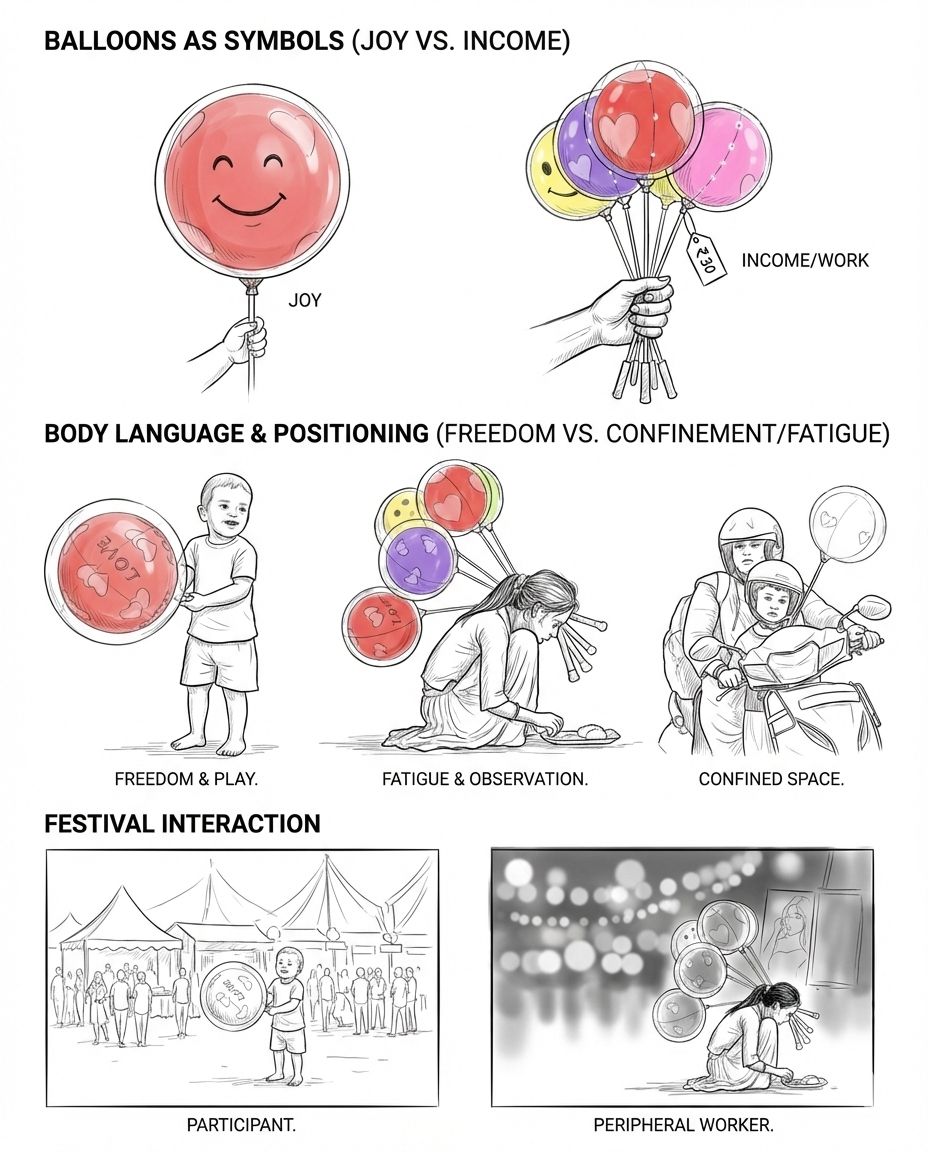
This project is about using pictures from festivals to show what Unequal Childhoods really looks like. Festivals are places where people have fun. Everything seems happy and fair.. If you look closely you can see that there are big differences between people. When I take pictures of kids at these festivals it shows how different their lives are, even when they are all, in the place celebrating. The Unequal Childhoods project uses festival photography to make this point. Rather than staging scenes, the images are captured from real moments, allowing childhood inequality to appear naturally through body language, surroundings, clothing, and roles.
This project is about kids who have to deal with money problems and learn to survive early in life. It shows what is really going on in the lives of these children. The pictures were taken when people were having fun and celebrating.. They also show that even when people are having a good time some kids are still struggling. Usually when people think of festivals they think of times being free and innocent.. For some kids festivals are just another time when they have to work or take care of things. The photographs show how the same place can be very different for kids. This project is, about the lives of these children. How they have to adapt to survive. Each picture shows a part of being a kid that is shaped by what happens to you rather than what you want. The pictures use things like balloons, lights and smiles to show that it is strange that happy times can happen at the time as unfair things. The balloons and lights are not just there to look nice they mean something. The balloons are like the kids dreams. How innocent they are and the way the kids look and where they are shows that they can deal with tough things take care of themselves and understand their feelings in a way that is surprising for how old they are. The photographs of children and balloons and lights really drive this point home because the children in these photographs are experiencing things that no kid should have to experience and the balloons and lights are like a reminder of the times but also of the tough times that the children are going through and how they are still managing to find joy in the midst of all the inequality that surrounds them and that is what the photographs are really about the children and their experiences, with balloons and lights and smiles. By documenting these moments without staging or interference, this project aims to create awareness rather than sympathy. It invites viewers to pause, observe, and reflect on their own role within such social realities. Ultimately, the work questions what childhood truly means in a society where survival often replaces play. Through photography, this project becomes both a record of truth and a call for empathy, care, and collective responsibility toward protecting every child’s right to a safe and dignified childhood.